
Honoring Our Independence: The Courage to Keep Pedaling Into a New Future
- Liz Donahey
- Jul 4
- 4 min read

Every year on the Fourth of July, we celebrate more than the birth of a nation. We celebrate the courage to believe that a better future is possible. As America commemorates 250 years of independence, I find myself reflecting on a question that extends far beyond our nation's history: What fears am I ready to declare independence from?
The story of the United States is not one of certainty. It is a story of extraordinary courage. On July 2, 1776, the Second Continental Congress voted in favor of independence. Two days later, on July 4, the Declaration of Independence was adopted, boldly proclaiming the colonies' commitment to liberty and self-government. The journey continued through years of hardship until September 3, 1783, when the Treaty of Paris officially ended the Revolutionary War and Great Britain recognized the United States as an independent nation. Finally, on March 4, 1789, the United States Constitution took effect, establishing the framework of government that continues to serve our nation today.
Looking back, history makes their success seem inevitable. It wasn't.
Those who pursued independence faced enormous uncertainty. They risked their livelihoods, their families, and in many cases, their lives. They did not know whether they would succeed. They simply believed that freedom was worth the risk.
That lesson still speaks to us today.
Our greatest obstacles are often not found on battlefields but within ourselves. Fear of failure. Fear of rejection. Fear of loss. Fear of not being enough. These fears quietly influence our decisions, our relationships, and the stories we tell ourselves about who we are.
Modern neuroscience helps explain why. According to Harvard Medical School, when the brain perceives a threat, the amygdala rapidly activates the body's fight-or-flight response through the hypothalamus and sympathetic nervous system. Adrenaline and cortisol prepare us to survive immediate danger by increasing our heart rate, sharpening our focus, and tensing our muscles. Thousands of years ago, this response protected us from predators and physical threats.
Today, however, our brains often react the same way to emotional challenges. Rejection, financial stress, conflict, public speaking, or the possibility of failure can trigger the same biological response as physical danger. Our nervous system is trying to protect us, even when the threat is no longer life-threatening.
The encouraging news is that our brains are capable of change. The prefrontal cortex, responsible for reasoning and thoughtful decision-making, helps regulate emotional responses when we pause, reflect, and choose our actions deliberately. Research shows that therapy, mindfulness, supportive relationships, and repeated experiences of safety strengthen these pathways over time. In other words, courage is not the absence of fear. Courage is learning to recognize fear without allowing it to make our decisions.
"The greatest declaration of independence most of us will ever make is freeing ourselves from the fears that have quietly governed our lives."
I have learned that our past explains us, but it does not have to define us. Many of us carry wounds from childhood, heartbreak, loss, rejection, or disappointment. Those experiences shape us, but they do not have to become our identity. Too often we respond to today's opportunities as though yesterday's pain is about to happen again. We hesitate because we remember failure. We withdraw because we remember rejection. We protect ourselves because we remember being hurt.
Healing begins when we recognize that yesterday does not have to determine tomorrow.
Human beings are wired for connection. We all long to love, to be loved, to belong, and to feel safe. Healthy relationships are not about finding someone to complete us. They are about two people choosing to grow together while each continues becoming stronger individually. Real independence is not about needing no one. It is about no longer allowing fear to govern the way we live, love, or dream.
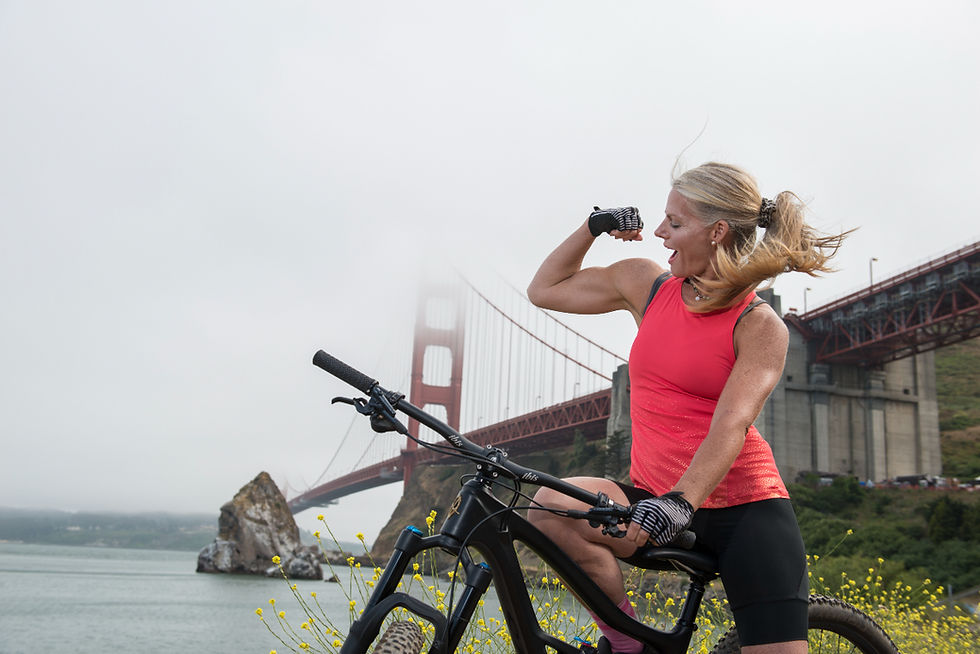
As mountain bikers, we understand this better than most. Every challenging climb asks us to trust ourselves. Every technical descent requires us to stay present instead of focusing on what could go wrong. We do not reach the summit by standing still. We get there one pedal stroke at a time.
Life works much the same way.
The founders of our nation could not see the America we know today. They simply believed it was worth building.
"The founders could not see the America we know today. They simply believed it was worth building. We cannot see every chapter of our future either, but we can choose to believe the best chapters have not yet been written."
As America commemorates 250 years of independence, may we honor the extraordinary courage of those who chose hope over fear. And may their example inspire us to make our own declaration of independence, from shame, resentment, self-doubt, and the stories that no longer serve us. May we choose courage over comfort.
May we choose hope over fear. May we keep pedaling toward a future greater than our past. Here's to new beginnings. Here's to freedom. And here's to becoming the people we were always capable of being.
Sources:
Historical information is based on the Declaration of Independence (1776), the Treaty of Paris (1783), and the United States Constitution (1789). Information regarding America's 250th anniversary (the Semiquincentennial) is supported by the America250 Commission, the National Archives, and the Smithsonian Institution. The discussion of the brain's stress response draws on educational resources from Harvard Medical School regarding the amygdala, hypothalamus, sympathetic nervous system, prefrontal cortex, neuroplasticity, and the fight-or-flight response. Reflections and interpretations are the author's own.
Get Ready to Ride? Join the Tam Together Ride on July 26th Benefiting the
Save 15% Now Thru July 10th with Promo Code: MTBCLUB15


Comments